
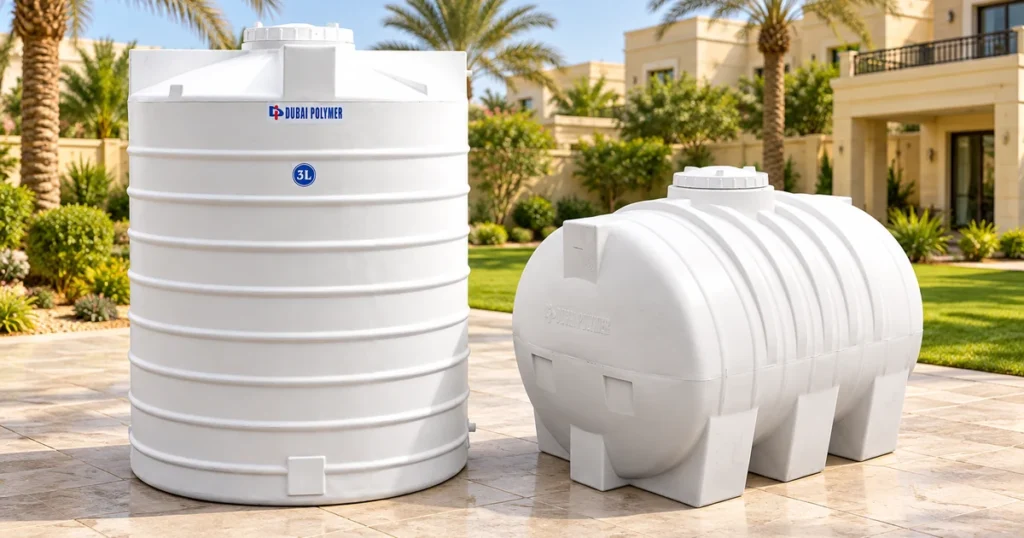
If a property needs 4,000 gallons of water storage, there may be more than one way to provide it.
You could install:
- One 4,000-gallon tank
- Two 2,000-gallon tanks
- Four 1,000-gallon tanks
The total storage capacity may be similar, but the installation does not work in exactly the same way. It completely depends on the Space, access, maintenance, plumbing, structural support.
When Does One Large Water Tank Make Sense?
A single large tank gives you the required storage in one unit.
This can make the system simpler because there are fewer tank connections, valves and interconnecting pipes to manage.
A single tank may be suitable when:
- There is enough installation space
- Access for delivery is clear
- The required tank dimensions fit the site
- A simple plumbing arrangement is preferred
- The full tank can be taken out of service when cleaning or repair is required
Advantages of One Large Tank
- Fewer pipe connections
- Fewer valves and fittings
- Simpler plumbing layout
- Easier system control
- One tank to inspect
- Less interconnection between tanks
It can also reduce the amount of plumbing work required compared with a multi-tank arrangement.
When Are Multiple Smaller Tanks Useful?
Multiple tanks divide the total storage requirement across two or more units.
This can be useful when one large tank cannot physically fit through the available space or within the installation area.
Smaller tanks can also give the project more flexibility.
For example, a requirement for 4,000 gallons can be arranged as two 2,000-gallon tanks instead of one 4,000-gallon tank.
This may help when:
- Height or width is restricted
- Storage needs may increase later
- Maintenance needs to be carried out without shutting down the entire storage system
- Different areas need separate water-storage arrangements
The exact setup still needs proper plumbing design.
Maintenance and Cleaning
Maintenance is one of the biggest differences between the two options.
With one large tank, the entire storage unit normally has to be taken out of service when the inside needs cleaning or certain repairs are required.
With multiple tanks, one tank may be isolated while another remains available.
But this only works if the system has been designed for independent isolation.
The installation may require:
- Separate isolation valves
- Correct inlet arrangement
- Outlet manifold
- Overflow connections
- Drain points
- Proper balancing between tanks
Simply placing two tanks next to each other does not automatically create a reliable backup system.
What Happens If One Tank Develops a Problem?
A single large tank creates one main storage point.
If that tank has to be emptied for inspection or repair, the full stored capacity may temporarily become unavailable.
Multiple smaller tanks can reduce this issue.
If there are two tanks and each can be isolated independently, one tank may remain operational while the other is serviced.
This can be useful for:
- Commercial properties
- Staff accommodation
- Industrial facilities
- Buildings where water availability is important
The remaining tank must still have enough usable capacity for the site’s needs.
Which Option Needs More Plumbing?
Multiple tanks normally require more plumbing.
A multi-tank arrangement may need additional:
- Inlets
- Outlets
- Overflow lines
- Drains
- Isolation valves
- Interconnecting pipes
- Manifold connections
The pipe layout also has to ensure that water moves through the tanks as intended.
Poorly designed connections can result in one tank filling or emptying differently from another.
A single large tank generally has a simpler fitting arrangement because there is only one storage vessel to connect.
What About Installation Space?
Do not compare tanks only by total capacity.
Check their actual:
- Diameter
- Height
- Length
- Maintenance clearance
- Access for installation
- Distance from walls
- Pipe connection space
One large vertical tank may use less floor area than several smaller tanks.
But in a location with height restrictions, multiple smaller or lower-profile tanks may fit more easily.
That is why the available space should be measured before choosing the arrangement.
Structural Load Still Matters
Water is heavy regardless of how many tanks hold it.
Dividing the same total volume between several tanks does not remove the total water load. It changes how that load is positioned and distributed.
This is particularly important for rooftop installations.
The supporting structure should be assessed for:
- Full operating weight
- Tank positions
- Base dimensions
- Load distribution
- Supporting platform or slab
- Maintenance access
Do not assume that several smaller tanks are automatically safer for a rooftop. Structural suitability should be confirmed by the appropriate project professional.
Which Setup Is Easier to Expand Later?
Multiple-tank systems can offer more flexibility when future expansion is expected.
With one large tank, increasing capacity usually means adding another tank anyway or replacing the existing unit with a larger one.
Future expansion should therefore be considered during the first design stage, including available space and pipe arrangement.
Water Turnover Should Also Be Considered
More storage is not always better.
If several tanks are installed but water demand is low, some stored water may remain unused for longer periods unless the system is designed to provide proper turnover.
The same issue can occur with one oversized tank.
The aim should be to provide enough storage for the actual requirement without creating unnecessary stagnant capacity.
This is why the required water-storage capacity should be decided before choosing between one large tank and several smaller tanks.
Quick Comparison
|
Factor |
One Large Tank |
Multiple Smaller Tanks |
|
Plumbing |
Simpler |
More connections required |
|
Installation access |
Needs space for one large unit |
Smaller units may be easier to position |
|
Maintenance |
Entire tank may need to be offline |
Individual tanks may be isolated |
|
Backup flexibility |
Limited |
Better if correctly designed |
|
Future expansion |
Less flexible |
Easier to expand in some installations |
|
Valves & fittings |
Fewer |
More |
|
System complexity |
Lower |
Higher |
|
Space use |
Depends on tank dimensions |
More flexible layouts possible |
Which Option Should You Choose?
Choose based on the project rather than simply choosing the biggest tank available.
Before deciding, check:
- Total required capacity
- Number of users
- Available space
- Height restrictions
- Delivery access
- Maintenance requirements
- Plumbing layout
- Pump arrangement
- Structural support
- Future expansion plans
Before Ordering
If you are unsure which arrangement fits your project, start with the required total water capacity and available installation area.
Dubai Polymer Industries is a water tank manufacturer in the UAE and offers different vertical and horizontal polyethylene water tank capacities. Share your required storage volume, available dimensions, installation location and project use before confirming the tank configuration.
FAQs
Can two water tanks work together?
Yes. Multiple tanks can be connected, but the inlet, outlet, overflow, valves and interconnecting pipes must be designed correctly so the system operates as intended.
Is it cheaper to install one large water tank?
A single tank may require fewer pipes, fittings and valves, but total project cost depends on tank size, access, transport, installation and site conditions.
Can one tank be used while another is being cleaned?
Yes, if the tanks are designed with independent isolation and the remaining tank can provide sufficient water for the property.
Do multiple tanks need separate overflow pipes?
The overflow arrangement depends on the plumbing design. Each tank must be protected against overfilling, and the overflow system must be able to handle the incoming flow safely.
Can I add another tank later?
In many cases, yes, provided there is enough space and the plumbing system has been planned for expansion.
How do I decide the total storage capacity first?
Calculate or estimate the site’s water demand, number of users, supply frequency and required backup period. Then compare suitable tank capacities and configurations.
What information should I provide before requesting a tank recommendation?
Provide the required total capacity, available space, installation location, number of tanks being considered, application and any height or access restrictions.